5/14/2013

Learning to understand what autistic people understand (or don't): What you see is not what you get

There are two opposite ways to misunderstand autistic people.  One is to assume they don't understand when they do.  The other is to assume they do understand when they don't.

My younger brother, who is very bright, had hyperlexia--a form of language development involving early reading, vocabulary, and mechanical knowledge, but delayed comprehension.  He loved Disney movies as a toddler, and we caught him spelling out "Walt Disney Pictures Presents" with alphabet blocks when he was two.  It can be hard to tell when a child growing up in a sea of words and books truly learns to read, but we think he taught himself to read when he was three.  Although he was late to talk and spoke very little at first, when he did start speaking, he had good vocabulary and grammar.  And when we spoke to him--the way my parents spoke to me, the way we'd speak to any verbally talented child--he seemed to give all the verbal and nonverbal indications that he understood.

But often, he didn't.

In retrospect, the signs were there.  There was a particular way he stared sometimes when I talked to him that looked like a deer in the headlights.  Eyes large and blank, mouth open.  I figured there was no way he couldn't understand me, so I thought he was doing it on purpose to annoy me.  It was only after the diagnosis of "Aspergers" that we realized that he really didn't understand.

Flappiness wrote a beautiful but often painful post about the opposite problem: struggling to presume competence in a child who gives none of the cues to understanding we expect.  TRIGGER WARNING: this may be hard to read if you yourself have been presumed incompetent.  The reason I'm quoting her here is that she *does* understand the importance of presuming competence, and tries to do it, but it might still be hard to hear why it's difficult.  If that's true for you, please skip to the end of the block quote and continue reading.  She writes:

“Always presume competence” can be a hard rule for non-autistic folks to follow.  That’s not because we don’t agree – at least in theory.  But severely autistic people may not give a lot of signals that they understand something.  They often do not appear to be listening or watching.  And, when you ask them to do something based upon what they have seen or heard, many do not respond as we would expect them to.  In the absence of any visual indicators demonstrating competence, it is easy to wonder whether understanding is happening at all.  For, somewhere in the back of a typical person’s head, we wonder why someone who understands doesn’t respond when it’s in his best interests.  It’s a lot like religion.  You can be taught the tenets of your faith.  You can reason out your belief system in your head.  But, in the day to day grind of living, it is natural to question what we cannot see.  We wonder if there is a God out there.  And we wonder if our severely autistic loved ones really comprehend all that is happening around them.  Maybe you’ve never wondered.  Maybe you are like those fortunate folks who have never doubted their faith.  But, if you’re like me, you have wondered, worried, and sometimes been haunted by the possibility that you are wrong.  Or even that you are right. 
When I began to be convinced of Callum’s autism, of the first things a mother of two autistic children told me was never to talk about him while he’s in the room and to always believe that he knows what is happening.  She related stories to me of her children recalling events from years earlier that she had believed they had not noticed. 
But they had.  And with perfect recall of the details.  Because they didn’t talk at the time or cooperate with what was requested of them, she had assumed they weren’t listening.  Having known them at that time, I would have agreed with her.  They didn’t appear to be listening at all.  At that time, they could barely talk.  No, we shouldn’t have assumed, but -unfortunately- it’s an easy mistake to make. 
Fast forward several years, and now I have an autistic little one of my own.  But even having heard her story, I questioned the truth of it with regard to my own child.  I’ll admit that I was somewhat confident of my own ability to read him.  I thought I would see the proverbial light bulb go off and then I would presume competence.  But Callum, in the grand tradition of children everywhere, has humbled me recently.  We are having a little “language explosion” you see.  Almost every day now, he is surprising us with knowledge he had – but had not previously shown. Knowledge I was so very afraid he wasn’t absorbing. 
Today, Callum spoke his name for the first time.  And I missed it.   It sounded more like “Cam”, so I didn’t pick it out of his typical babble chatter until he said it a few more times–while waving at his own reflection in the mirror.  (Yeah, I know.  Sometimes, I am not so smart.)  I remember turning and asked him if he’d said “Callum”.  So he looked back to the mirror, waved at himself again, and said, “Callum” — with the sweetest smile.  I’m sure I stopped breathing for just a moment.  Overjoyed though I was that he finally said his own name, what hit me was his determination to be seen and heard.  He kept on – until I got it — and then confirmed it.  Apparently, he was motivated to speak his name by the reflection of himself in the mirror.  A reflection he liked. 
So, now I must learn how to adjust the mirror in my eyes to reflect who he really is and who he can be.  Because he is watching.  He is listening.  He is learning.And when he looks at himself through me, I want him to like and be inspired by what he sees.  For, if what he sees in my eyes is not faith in him, how will learn faith in himself?

All right, everyone back with us?

The problem is, most of us have a certain set of verbal or nonverbal cues we automatically assume mean understanding, and another set that we automatically assume mean incomprehension.  A particular sort of fixed-but-not-too fixed eye contact; nodding; mimicking our movements; interrupting only to ask an appropriate question or to "follow on" or "elaborate"--these and others seem to say, "I understand."  Blank eyes, furrowed brow and puzzled facial expressions, looking around a lot, shrugging, unusual silence without questions and comments--these and others say, "I don't understand."  And most of the time, for most people, these work--otherwise, we'd have a different set of assumptions.  The problem, though, is these interpretations don't feel like interpretations.  They're automatic.  You look at someone and see "they understand" or "they don't understand what I'm saying" the way you look at the sky and see it's blue.  It takes a thoughtful person to even see how you could question it.  You see it, it's there.

But autism doesn't work like that.

It's been said that autistic kids are monotone (but really, their pitch is wider-ranged and more variable than the average person's; we just don't hear it because we don't expect it 1,2,3,4).  It's been said that autistic kids have a poker face.  I don't know of any studies actually investigating this, but my guess is it's true for only a few.  The rest probably have subtle, or just different, expressions we don't know how to interpret.  It's been said that autistic people don't express their feelings, even know what they are, until they explode in a dramatic meltdown of tears and yelling and maybe even flying fists.  Maybe--but isn't it also possible that we don't see the warning signs before the meltdown the way we might with a typically developing kid who is overtired, hungry, and on the way to a similar meltdown?  It's been said that autistic kids are in their own world, that they don't express love.  And it's true that many don't like hugs, don't point, don't follow their mothers' joint attention.  But they feel connected and learn new words when their parents follow their joint attention, just like any other kid 5,6,7.  And some autistics, such as Ballestexistenz, have pointed out in video recordings all the signs of love and caring that autistic kids show.  Ones that weren't conventional, weren't expected, and so they were missed.

There's a lot of emphasis on teaching autistic kids to understand how and why neurotypical people behave the way they do.  And there should be, so autistic kids no longer feel so adrift on the "wrong planet" where the rules don't make any sense  There's a lot of emphasis on teaching autistic kids to emit the cues we're expecting, so we know how to interpret their feelings and behavior.  And this is a great thing for autistic people to be able to do, especially when dealing with people they'll only have to deal with once or twice, who aren't going to invest the time to learn their cues.  But parents, siblings, spouses, and friends who want to learn how to interpret their autistic loved one's cues are on their own.  Only like-minded neurotypicals and autistic adults are encouraging them to do it.  Most don't even know it needs to be done.  Unfortunately, a lot of neurotypical parents, siblings, spouses and friends don't seem to realize that either.

And here's something everyone in the autistic community should know: it's hard to undo conditioning you didn't even know you had, that's as basic as seeing that the sky is blue, and replace it with....what?  As hard as it is to undo your basic reactions, as much patience and self-questioning as it takes, at least you know what's required.  But when trying to figure out the real cues, how do you know what to look for?  It's even harder if your autistic loved one can't speak and tell you if you're on the right track.  This is one of the most valuable things autistic bloggers do: not only do they tell you what the world looks like from their perspective, but you can sometimes catch little glimpses of what they look like from the outside, so you can tell whether your autistic loved one is experiencing a similar emotion.

This is a hard struggle, and I can understand why people looking only for casual friendships or acquaintanceships might be scared off by the work required (although as Rachel Cohen-Rottenberg points out, they are placing their own convenience above another human being's need to feel connected).  But I think anyone who loves an autistic person and is connected with them in some long-term way is obligated to try.  We need to question our assumptions, observe our autistic loved one closely, ask them and other autistic people about anything we don't understand (and there will be a lot of questions--and probably should be).  (By the way: not every autistic person always feels up to answering, or wants to field questions, something we should also respect--and ask someone else).

We probably will fail, a lot.  We need to be patient with ourselves and keep trying.  And if the autistic person in our lives grows up and one day asks, "why did you do this horrible thing?" We have to be able to look them in the eye, apologize, and say, "I'm sorry, I did the best I could, but I didn't understand."  

To acknowledge that replacing our automatic social assumptions is hard is not an invitation to engage in a "woe is me" pity party.  We only have to learn to interpret a new set of social cues, not learn to imitate them ourselves--the autistic people in our lives have a much more difficult struggle than we do.  For other non-autistic people, it's about realistically confirming, sympathizing, validating: yes, this is the unique situation involved with loving someone with autism, no, you're not alone, yes, it's hard, and yes, it's OK to feel overwhelmed sometimes, even if other people have harder struggles. For autistic people, it's about understanding that when we (inevitably) screw up sometimes, it's not out of malice.  Some of us really are doing our best, and are open to learning, but we have our own limitations of time, energy, patience, or mental health to deal with.  So please bear with us as we keep learning.      

The world may not always understand the autistic person in our lives, no matter how "typical" they may have learned to appear.  But I'd like to think that we can.

References:

  1. Yoram S. Bonneh, Yoram Levanon, Omrit Dean-Pardo, Lan Lossos, & Yael Adini (2010). Abnormal speech spectrum & increased pitch variability in young autistic children. Frontiers of Human Neuroscience 4: 237.
  2. K. Hubbard & D.A. Trauner (2007). Intonation and emotion in autistic spectrum disorders.  Journal of Psycholinguistics Research 36, pp. 159-173.
  3. A. Nadig & H. Shaw (2012). Acoustic & perceptual measurement of expressive prosody in high-functioning autism: increased pitch range and what it means to listeners. Journal of Autism & Developmental Disorders vol. 42 Iss. 4, pp. 499-511.
  4. Megha Sharda, T. Padma Subhadra, Sanchita Sahay, Chetan Nagaraja, Latika Singh, Ramesh Mishra, Amit Sen, Nidhi Singhal, Donna Erickson, & Nandini C. Singh (2010). Sounds of melody--pitch patterns of speech in autism. Neuroscience Letters Vol. 478 Iss. 1, pp. 42-45.
  5. Michael Siller & Marian Sigman (2002). The behaviors of parents of children with autism predict the subsequent development of their children's communication. Journal of Autism & Developmental Disorders vol. 32 Iss. 2, pp. 77-89.
  6. Michael Siller & Marian Sigman (2008). Modeling longitudinal change in the language abilities of children with autism: parent behaviors and child characteristics as predictors of change. Developmental Psychology Vol. 44 Iss. 6, pp. 1691-1704.
  7. Twyla Y. Perryman, Alice S. Carter, Davniel S. Messinger, Wendy L. Stone, Andrada E. Ivanescu, & Paul J. Yoder (2012). Brief report: Parental child-directed speech as a predictor of receptive language in children with autism symptomatology. Journal of Autism & Developmental Disorders.


5/13/2013

Pop Culture meets psychology in #FakePsychSciTitles meme


It all started with a set of tweets by Simon Dymond complaining about the titles of the articles in the journal Psychological Science:
Another issue of Psych Science is out. That means another bunch of super snappy article sub-titles that promise a lot but deliver little… -simon dymond @zorroesque  
Would an Obese Person Whistle Vivaldi? Who Rises to the Top? NASA Faked the Moon Landing. Putting All Your Eggs in One Basket. #PsychSci  –simon dymond @zorroesque  
Stuck in the Past. The Curse of Planning. What Sleeping Babies Hear. Friends Shrink Foes. #PsychSci –simon dymond @zorroesque

To which Mark Baxter replied:
Oh my God, those are real. I thought you were taking the piss. –Mark Baxter @markgbaxter 
That’d be a good one, actually. “Taking the piss: Bladder control and executive function in 3-year-olds.” –Mark Baxter @markgbaxter

And they were off.  A new meme had begun.

The one that started it all for me was this:
I Like Big Butts And I Cannot Lie: Waist-To-Hip Ratio Preference is Correlated With Truthfulness. –Kyle Jasmin @kylejasmin
It had everything.  The ridiculous and somewhat inappropriate pop-culture references; the correlation of bizarre, unrelated phenomena of social interest.  I was hooked.

Here are the ones I liked.  You can find other early ones at Mark Baxter’s list.

My absolute favorites:
1.     What is it like to be a Bat-man? Exploring the mind of a playboy-ninja with psychopathic tendencies. –Fernando Blanco @FBpsy (Anything that combines one of my favorite papers of all time, Batman, and this meme will always get my #1 vote).
2.     All You Need is Love (And a Few More Subjects): Underpowered Experiments in Psychology. –Rolf Zwaan @RolfZwaan
3.     I am the walrus: Body dysmorphia in English Adult Males. –Rolf Zwaan @RolfZwaan
4.     I don’t care if Monday’s blue: Increased apathy among synaesthetes. –Nick
5.     There Will Be an Answer, Let it β  Balancing Type I and Type II Error Rates in Psychological Research. –Kyle Jasmin @kylejasmin
6.     The elephant in the room: Pictures of pachyderms prime discussion of controversial topics. –Dan Lurie @dantekgeek
7.     Monkey see, monkey poo: The relationship between scat throwing and primate theory of mind. –gameswithwords @gameswithwords
8.     The answer my friend is blowing in thewind’ – does flatulence augment problem solving? –Michael Quinn @neurophilomath
9.     Message in a bottleneck: The role of memory constraints in shaping human language. –Christian Kliesch @antipattern (This one wins “most believable.”  If it isn’t already in Psych Sci, it should be!).
10. Can’t touch this: real world grasping of illusory objects. –Bobby Stojanoski @bstojanoski
11. Everybody hurts…sometimes: A new look at seasonal affective disorder.” –Jeremy Newton, @NewtPsyc
12. I Can Has Cheezburger? Dietary Lipids as a Risk Factor for Specific Language Impairment in Housecats. –Marc Joanisse @drmarcj (Finally, an explanation for LOLcats!).

These ones are quite funny, if you like meta, psychological jargon, or statistics:
1. Power Corrupts, But Lack of Power Corrupts Absolutely: We Replicated This Effect 7 Times in a Row at p = .048. –Sanjay Srivastava @hardsci  
2. All your Bayes are belong to us. –Suzanne Sengerstrom @suzannecarrie  
3. Making a silk purse out of a sow’s ear: Snappy subtitles influence perceived significance of results. #FakePsychSciTitles #media –Mark Baxter @markgbaxter  
4. SNARC, the Herald Angels Sing: Supernatural Thinking Strengthens Spatial-Numeric Associations (by an off-Twitter friend). –Kyle Jasmin @kylejasmin (The SNARC effect is a spatial-numerical association revealed by small differences in reaction time).  
5. The Tea-Test: Social conventions in upper class British society. –Matt Wall @m_wall
6. All I want to get is, a little bit closer: peripersonal space, embodiment, and the rubber hand illusion. -sarcastic_f sarcastic_f 
7. FFT analysis of eye mouvement speed: the fast and the fouriers. -Pete Etchells @DrPeteEtchells 

You don’t have to know anything about statistics or psychological trends to appreciate these (organized by author--first character).  Be careful about following the links to the songs referenced--some may not be appropriate for children (in the spirit of meme-referencing going on today, Hide your wife! Hide your kids!).

Smells Like Teen Spirit: Adolescence-Specific Olfactory Cues for Age Identification. –Aaron Kucyi @neuroperson 
That Joke Isn’t Funny Anymore: The Increased Incidence of “Amusing”Titles in Psychology Research. @RolfZwaan. –Ben Ambridge @Benambridge  
Some like it hot: Neural correlates of inter-individual differences in orofacial reaction to spicy food. –Benjamin Saunders @BenSaunders  
Brain Farts: Statistical fMRI Imaging Indicates Flatulence-Like Artifacts in Active Memory Retrieval. –Charlie Harrison @SeizeTheHay  
Fifty shades of grey: Complex monochromatic perception judgements. –Chris Moulin  
I said it before and I will say it again: Syntactic variation, repetition, and memory. –Christian Kliesch @antipattern  
People Are Strange When You’re a Stranger: Perception of similarity in the minimal group paradigm. –Christian Kliesch @antipattern  
Bittersweet Symphony: Evidence for Music-Taste Synesthesia. –Dan Lurie @dantekgeek  
525,600 Minutes: Compulsive counting of time intervals in the urban creative class. –Dan Lurie @dantekgeek  
My bologna has a first name: EEG signatures of discourse comprehension in imagined conversations between children & food. –Dan Lurie @dantekgeek  
I’ve got my mime set on you: The role of non-verbal communication in romantic partner choice. –Dan Lurie @dantekgeek  
Cast your mind back: fishing increases retrieval in long-term memory. –Darren Rhodes @Darren_Rhodes  
Consequences of Erudite Vernacular Utilized Irrespective of Necessity: Problems with Using Long Words Needlessly – (1/2). –Darren Rhodes @Darren_Rhodes  
“You looking at me?”: Gaze perception in antisocial personality disorder. –Deborah Apthorp  
Rock With You: A mother’s up-close and personal story on Autism Spectrum Disorder. –El Bandita @ImALegalAlien  
Here Comes the Sun: Edward Cullen on overcoming his battles with Phengophobia. –El Bandita @ImALegalAlien  
Crank Dat (Superman dat ho): The implications of visual-spatial disorders affecting the modern-day dance floor. –El Bandita@ImALegalAlien  
I want you (She’s so heavy): A qualitative inquiry into the sexual practices of female Sumo wrestlers (by a FB friend). –El Bandita @ImALegalAlien  
Beat It: The Psychological Effects of Semen-loss syndrome in China. –El Bandita @ImALegalAlien  
Livin’ on a Prayer: Religiosity and Longevity in a Longitudinal Sample. –gameswithwords @gameswithwords  
Might as well face it, you’re addicted to love: coping strategies in sex addicts. –James Gilbert @james_gilbert  
I believe I can fly: development of motor control in Drosophila. –James Gilbert @james_gilbert  
Everybody do the dinosaur: Interbreeding, not extinction, accounts for the lack of a continuous sauropod fossil record.” –James Gilbert @james_gilbert  
Walk like an Egyptian: five millennia of Middle Eastern gait patterns.” –James Gilbert @james_gilbert  
Papa don’t preach: long-term effects of growing up in an apostate household. –James Gilbert @james_gilbert 
 It’s the End of the World As We Know It (And I Feel Fine): A Qualitative Analysis of Optimism in Doomsday Cult Members. –Jon Sutton @jonmsutton  
Love Me Tender: The Romantic Sequelae of Tactile Sensitivity. –Jon Sutton @jonmsutton  
You Only Live Once: The influence of mortality salience on risk taking behavior. #yolo. –Joseph Tan @jdottan  
We will never ever get back together: Multiple breakups with the same romantic partner. –Joseph Tan @jdottan  
That’s Me in the Corner: Impaired Spatial Navigation Following Negative Courtship Outcomes. –Kyle Jasmin @kylejasmin  
It’s A Little Bit Funny, This Feeling Inside: Abnormal Interoception in Songwriters. –Kyle Jasmin @kylejasmin  
Subterranean Homesick Blues: Affect, Nostalgia & Diasporic Identification among migrant Tube workers. –Marc Scully @marcdonnchadh  
Burning up for your love: Induction of hyperthermia by amorous states. –Mark Baxter @markgbaxter 
 Do You Believe in Life After Love? Retrospective Reevaluation of Intimate Relationships. –Mark Baxter @markgbaxter  
Second Hand Rose: Previous Ownership Affects Neuroeconomic Indices of Perceived Utility and Value. –Mark Baxter @markgbaxter  
Remembrance of Things Now: Madeleines increase performance in a short-term recall task. –Mark James Adams @mja (Hope they used some other pastry in the control condition—I bet the sugar rush helped!).  
Nobody puts baby in a corner: Effective child-rearing strategies in igloo-dwelling Arctic populations. –Matt Wall @m_wall  
You had me at ‘hello’: mating behavior of incredibly promiscuous people. –Matt Wall @m_wall  
You can say that again! A case study of compulsive psychogenic echolalia. –Matt Wall @m_wall  
Poultry in motion: A study of the reasons for road-crossing behavior in Gallus Gallus Domesticus. –Matt Wall @m_wall (A pun plus “why did the chicken cross the road?” Extra points to Matt Wall).  
Can’t get you out of my head’: can exposure to antipodean pop music induce obsessive rumination? –Michael Quinn @neurophilomath  
If you don’t know me by now…’ Can listening to soul classics induce anterograde amnesia? A study. –Michael Quinn @neurophilomath  
Comfortably Numb’: IKEA furniture a risk factor for opiate abuse? –Michael Quinn @neurophilomath  
A word in the hand is worth 2 in the mouth: the communicative power of gesture. -@mosaicofminds  
Still Crazy After All These Years: Outcomes for schizophrenic patients in old age. -@mosaicofminds  
Is a picture worth 1000 words? An objective way to measure the representational content of images. -@mosaicofminds  
Haven’t got time for the pain: Feelings of hurriedness reduce pain perception. -@mosaicofminds  
Oops I Did it Again: Neural correlates of error detection in adolescent girls. -@Mosaicofminds  
This scene is a g*ddamn arms race: New PhDs’ perceptions of their career prospects post-#NIHSequester. -@mosaicofminds  
Light my fire: Lighting a fire kindles romantic affections (Yet another “embodied social cognition” study). -@mosaicofminds  
Baby’s in Black: Black clothing increases women’s perceived attractiveness. -@mosaicofminds  
I’m blue da ba dee da ba die: Unique characteristics of depression in synesthaetes. -@mosaicofminds  
I Feel Good, So Good, Now I’ve Got You: The thought of a loved one has analgesic effects in chronic pain patients. -@mosaicofminds  
(1/2) While My Guitar Gently Weeps: The tendency to attribute anthropomorphized emotion to instruments during music listening… 
(2/2) this anthropomorphism of instruments lacking in #autism, seen as deficit. -@mosaicofminds  
I Got 99 Problems: The role of counting in rumination in Obsessive Compulsive Disorder and depression. -@mosaicofminds  
Do birds of a feather flock together, or do opposites attract? Effects of similarity on romantic partner choices. -@mosaicofminds  
I’ll have to say I love you in a song: Musical declarations of love are perceived as more romantic than verbal ones. -@mosaicofminds  
Will you still need me, will you still feed me when I’m 64?: Fears of abandonment in adults approaching old age. -@mosaicofminds  
I’ve Just Seen a Face: Time course of learning to recognize novel faces during the love-at-first sight response. -@mosaicofminds  
Picture yourself on a boat on a river: Guided visualization induces calm in people with high trait anxiety. -@mosaicofminds  
Everybody loves you when you’re 6 foot in the ground: Judgments of loved ones as well as celebrities improve after death. -@mosaicofminds  
Why do fools fall in love?: Negative correlation between IQ and likelihood of infatuation is moderated by impulsivity. -@mosaicofminds  
I’m so happy ‘cause today I found my friends, they’re in my head: Positive functions of schizophrenics’ imagined companions. -@mosaicofminds  
It’s hard to be a saint in the city: looser moral judgments in city dwellers than rural and suburban dwellers. -@mosaicofminds  
I’m a Barbie Girl In a Barbie World: The branding of girls’ identities in a consumerist society. #FakePsychSciTitles #fakegenderstudiestitles. -@mosaicofminds  
My Milkshake Brings All the Boys to the Yard: Dietary Preference and Nutritional Incentivisation in Pubescent Males. –Dr. Neil Martin @ThatNeilMartin  
What Would You Do if I Sang Out of Tune?:  Unpredictability, Social Ostracism and Discordant Stimulation. –Dr. Neil Martin @ThatNeilMartin  
Behavioral Modification using Terpsichorian Intervention in a West Wales Sample: ABA using ABBA in ABER. –Dr. Neil Martin @ThatNeilMartin    
Ground-Breaking Studies: Do They Break Concrete? –Dr. Neil Martin @ThatNeilMartin  
Ice, ice, baby: High fecundity among high-Arctic First Nations societies. –Nick Davis @n_j_davis  
Should I Stay or Should I Go?: Impaired Decision Making Skills During Fear Response. –Nicole Introvert @nicoleintrovert  
Call Me Maybe: An analysis on telecommunications and indecisiveness in adolescents. –Nicole Introvert @nicoleintrovert  
We’re Up All Night to Get Lucky: Those with late-shifted chronotypes are more likely to procreate.” –Noah Gray @noahWG  
Murder on the dance floor: correlation between music taste and aggression. –Ollie @Ollieomara  
“Thought for food: brains from people with higher IQ are more likely to be eaten by zombies” –Pedro Bek @pedrobek  
Mo’ money, mo’ problems: deleterious effects of monetary incentives on cognitive performance. –Ravi Mill @RaviMill  
Women, MRI-te? Gender mediates individual differences in the BOLDresponse. –Ravi Mill @RaviMill  
I am the one and only: emergence and progression of delusions of grandeur in “Type 1” Schizophrenia. –Ravi Mill @RaviMill  
I Can’t Get No Satisfaction: Sexual Dysfunction Causes Syntactic Anomalies. Rolf Zwaan @RolfZwaan   
You’re as cold as ice: beverage temperature affects mate choice at speed dating events. –sarcastic_f @sarcastic_f  
Here today, gone tomorrow: the ephemeral nature of academic hashtag memes on Twitter. –sarcastic_f @sarcastic_f 
Sweet dreams are made of this: Agreeableness and openness toexperience correlating with sleep quality. –Sci Curious @scicurious  
Gangnam style: Experimental evidence for Psy. –Suzanne Segerstrom @suzannecarrie  
I Knew You Were Trouble: Failure to Integrate Trustworthiness Information in Mate Selection. –Vaida Rimeikyte @vaidarim  
Ice Ice Baby: Cooling Infants Helps Prevent Brain Damage. –Vaida Rimeikyte @vaidarim
UPDATE:  People are still posting hilarious #FakePsychSciTitles!  My favorites are in bold.
I Could Tell You, But Then I'd Have to Kill You: A Unique Method of Assuring Double-Blinding. -A C @the_crazy_dwarf 
Another One Bites the Dust: Elevated Rates of Pica Among Pregnant and Nursing Women. -Benjamin Saunders @BenSaunders 
Heaven Knows I'm Miserable Now: Religiosity Correlates with Major Depressive Disorder. -Benjamin Saunders @BenSaunders 
Don't Fall Apart on Me Tonight: A study claims that half of the American population use vibrators and sexual toys. -El Bandita @ImALegalAlien  
We're Lost in Music: Lack of spatial awareness and gustatory perception as exhibited by dubstep enthusiasts. -Jay Dadlani @NeuroWhoa 
Guns, Germs, and Stealing: Exploring the Link Between Infectious Disease and Crime #realEvoPsych http://t.co/9zVwuODFO0.  -Joanna Bryson 2 @j2blather 
Grate(d) Expectations: Delay of appetitive gratification in the house mouse (M. musculus). -Kane_WMC_Lab @Kane_WMC_Lab 
When The Moon Hits Your Eye Like a Big Pizza Pie: Striking Illusions of Size and Distance by Practicing Proctologists. -Kane_WMC_Lab @Kane_WMC_Lab 
Bitches Be Crazy: The Fluctuating Female Vote: Politics, Religion, and the Ovulatory Cycle (Actually kind of real). -Leslie Berntsen @leslie_bern 
Meme all the things!: Perseveration and echolalia in modern online culture. -@mosaicofminds 
Making a molehill out of a mountain: Content analysis of the DSM-5 committee's reactions to concerns about the new DSM. -@mosaicofminds 
Turning straw into gold: Frequency of massaging p-values in psychology research. -@mosaicofminds 
Fear Factor: The amygdala theory of social disabilities #realtheoryofautism -@mosaicofminds 
There will be an answer, let it be: putting aside a problem facilitates insight. #realcreativityresearch -@mosaicofminds 
Back to the Future: Depressed people perceive the future as (literally) behind them #fakeembodiedcognitiontitles. -@mosaicofminds 
Life in the fast lane: Frequent running causes career advancement via embodied priming #fakeembodiedcognitionstudies 
There is no spoon: Experiences of chronic fatigue syndrome and fibromyalgia. -@mosaicofminds (This references the "spoon" analogy of disabling fatigue).
Stuck Inside a Cloud: Comparison of "brain fog" in ADHD and Fibromyalgia. -@mosaicofminds 
Waiting on the world to change: Causes and correlates of political apathy. -@mosaicofminds 
I heard it through the grapevine: Quantitative techniques for tracking the spread of a rumor through a social network. -@mosaicofminds 
You say why, I say I don't know: Reasons for lay dissatisfaction with scientific explanations. -@mosaicofminds 
Never gonna give you up, never gonna let you down: role of rickrolling in the formation of strong Internet communities. -@mosaicofminds 
Eight days a week: Difficulties with calendar knowledge and calendar reading in children with dyscalculia. -@mosaicofminds 
Where are they going without ever knowing the way?: Real-world navigation with severe visual-spatial disorders. -@mosaicofminds 
You say yes, I say no: Compulsive contradictory responses in children with Oppositional Defiant Disorder. -@mosaicofminds 
Running on empty: A comparison of decision-making under ego-depletion, physical hunger, and fatigue. -@mosaicofminds 
I approve this message: Strategies for managing personal information and identity on social media. -@mosaicofminds 
I don't want clever conversation, don't wanna work that hard: Influence of SLI on romantic partner choices. -@mosaicofminds (I've always thought Billy Joel's song "Just the Way You Are" is more insulting than romantic). 
I can't save you from my poor brain: A qualitative analysis of the effects of mental illness on romantic relationships. -@mosaicofminds 
Love will keep us alive: Lower suicide rates among depressed people in romantic relationships. -@mosaicofminds 
Hungry like the wolf: pictures of predators prime hunger #fakeembodiedcognitionstudies -@mosaicofminds 
I wish that I had Jessie's girl: Unavailable women are perceived as more attractive. -@mosaicofminds 
Smooth criminal: "smooth" men appear less trustworthy yet more attractive. -@mosaicofminds 
You can't hide your lyin' eyes: People can detect unfaithfulness from photographs of strangers using eye gaze cues. -@mosaicofminds 
It's Raining Men, Hallelujah: Meterological Consequences of Devotional Motivation in Ladies. -Neil Martin @ThatNeilMartin 
Snowdrops And Daffodils Remind Me of You: An Extreme Case of Visual Agnosia. -Neil Martin @ThatNeilMartin 
Bringing it All Back Home: A Review of Studies on Compulsive Hoarding. -Stuart Ritchie @StuartJRitchie 
Ob-la-di Ob-la-da la la la la life goes on: The effects of echolalia on quality of life measures. -the wiles @darealwiles

Which are your favorites?  Feel free to share your own #FakePsychSciTitles in the comments!

5/12/2013

Why complete a sentence when you can repeat it?: Thoughts about language in ASD

I was reading a paper on methods for researching language development in autism (by Helen Tager-Flusberg1) when I came across the following fascinating tidbit:


"If a child with autism is asked to describe an event enacted by an experimenter or depicted in a photograph or a sequence of pictures that create a story, he or she is just as likely to simply name the objects (e.g., Tager-Flusberg, 1995) as to provide a narrative description..."

And, further:


"Sentence completion tests or sentence formulation tests (which involve asking a child to create or complete a sentence using a word or phrase given by the tester) are often not easily completed by children with autism. ...Autistic children may misunderstand the instructions and imitate what they have heard, rather than ending or formulating their own utterance."

This fascinates me because it seems so characteristically autistic...or at the least, something a neurotypical child wouldn't do.  I also have no idea why they would respond this way.

A researcher would ask: do autistic children have difficulty with the particular tasks they're given, or with completing sentences or constructing narratives in general?  

This problem has been addressed in a variety of ways.  One theory holds that autistic children lack an understanding of "pragmatics," the unspoken contextual and social rules that underlie the use of language.  Pragmatics come into play when the literal words of a sentence could be interpreted in multiple ways.  For example, in the Hobbit, when Bilbo says "good morning" to Gandalf the wizard, Gandalf points out all the meanings the phrase could imply:


"Do you wish me a good morning, or mean that it is a good morning whether I want it or not; or that you feel good this morning; or that it is a morning to be good on?"

Pragmatics involves the ability to use prior knowledge about the use of the phrase, the particular speaker, and the present conversation to determine which meaning a phrase like "good morning" implies.  This account tends to be popular with "theory of mind" researchers, who believe the social disability involved in autism causes difficulties with pragmatics.

Another theory holds that autistic people are bad at semantics--understanding, remembering, and manipulating the meanings of words.  In a neurotypical child, this would be the first explanation given for failure on tasks like these, which are supposed to be based on semantics.  

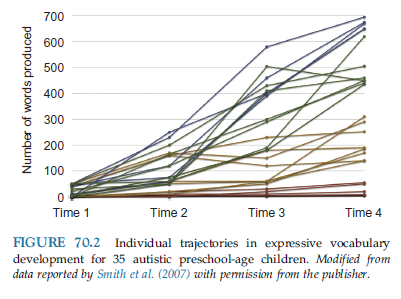
However, it's possible that autistic children simply don't have the language comprehension ability (or as researchers put it, "receptive language") to understand the instructions.  A number of studies2,3,4,5 suggest that autistic children--or at least, those with language delays--can actually produce more words and more complex sentence structures than they can understand.  

Furthermore, the tendency to repeat language one hears verbatim out of context--echolalia--is related to receptive language ability.  One study with 18 4-12 year old autistic children found that the poorer autistic children's receptive language abilities were, the more likely they were to use echolalia6.  They often used it combined with a "yes" or "no" to answer questions, in the following manner:


Parent: Do you want some juice?
Child: Do you want some juice? Yes.

In a situation where people are likely to mishear each other or miscommunicate, they often cope by repeating what the other person said to check for misunderstandings.  For example, at a drive through, good cashiers will repeat an order, and savvy customers will ask them to do so.  A person with difficulties understanding what other people say might want to follow a similar strategy--and autistic children might be doing the same thing.  In the example above, one can predict the child's response would then be "Do I want some juice? Yes."  

But now suppose the child also has difficulties with grammar, particularly pronouns (which often happens in autism).  Not only might they be unable to construct the sentence "yes I want some juice," they might not even change the pronoun when they repeat the parent's question.  The result: echolalia.

So how can researchers test whether autistic children understand the questions we're asking them?

There's actually a fairly simple experiment one could do.  Quite possibly, it's already been done.

First, you give an autistic child the standard instructions and ask them to complete or create several sentences.  Observe whether they do so or repeat the prompts.

Tell the child they can take a break for a few minutes and play with some toys in the room.  Then bring the child's parent into the room (to prevent the child from getting anxious, it's better to involve a familiar person rather than an unfamiliar "confederate" of the experimenter).  

Tell the child you're going to play the same game with the parent now.  Then give the parent the same task with the same instructions you gave the child.   Make sure the parent knows to focus on the experimenter and not the child--don't allow them to talk to or make hinting gestures toward the child.  This gives the child an opportunity to see how the task is actually supposed to be done.  When the parent has answered a number of questions, tell them they're done and lead them out.  Once the parent leaves the room, tell the child it's time to play the game again.  

If a child repeated the prompts the first time and completes or constructs sentences the second time--however clumsy the attempt--then seeing the parent modeling the task enabled him to understand it.  

Most people get better at a task when they do it more than once.  To make sure participants don't get better just based on doing the task twice, one could assign some of the children to a control condition.  They would do the task twice with a break in the middle, but they would only play with toys during the break, and would receive the same instructions both times.  

The difficulty here would be in interpreting null results--what would it mean if the child continued to repeat the prompts instead of following instructions, even after their parent modeled the appropriate response?  Were they not paying attention to what their parent was saying?  Could they understand the task, but lack the ability to produce the sentences?  

What do you think?  If you're autistic, or have an autistic child, any ideas why children might be responding this way?  If you're a researcher, has this experiment been done?  If not, is it worth doing? 

References
1 Tager-Flusberg, Helen (2000). The challenge of studying language development in children with autism. In Methods for Studying Language Production, pp. 313-332.
2 K. Hudry, K. Leadbitter, K. Temple, V. Slonims, H. McConachie, C. Aldred, P. Howlin, T. Charman, PACT Consortium, J. Green, A. Pickles, W. MacDonald, L. White, C. Holt, D. Kapadia, K. Bourne, L. Blazey, T. Houghton, C. Taylor, A. Le Couteur, A. Cutress, S. Leach, S. Barron, R. Colmer, S. Randles, K. Beggs, J. Collino, B. Barrett, & S. Byford (2010). Preschoolers with autism show greater impairment in receptive compared with expressive language abilities. Internatl. Journal of Language & Communicaiton Disorders Vol 45 Iss 6, pp 681-690. 
3 J. Maljaars, I Noens, E Scholte, & I van Berckelaer-Onnes (2012). Language in low-functioning children with autistic disorder: differences between receptive & expressive skills and concurrent predictors of language.
4  J. Volden, I.M. Smith, P. Szatmari, S. Bryson, E. Fombonne, P. Mirenda, W. Roberts, T. Vaillancourt, C. Waddell, L. Zwaigenbaum, S. Georgiades, E. Duku, & A. Thompson (2011). Using the preschool language scale, 4th edition to characterize language in preschoolers with ASDs. American Journal of Speech-language Pathology Vol. 20 Iss. 3 pp 200-208
5 Susan Ellis Weismer, Catherine Lord & Amy Esler (2010). Early language patterns of toddlers on the autism spectrum compared to toddlers with developmental delay. Journal of Autism & Developmental Disorders Vol. 40 Iss. 10, pp. 1259-1273.
6 Robin E. McEvoy, Katherine A. Loveland, & Susan H. Landry (1988). The functions of immediate echolalia in autistic children: a developmental perspective. Journal of Autism & Developmental Disorders Vol. 18 Iss. 4 pp. 657-668. 

5/10/2013

Why do autistic people reverse pronouns? An extremely preliminary look at the literature

Elizabeth "Ibby" Grace of Tiny Grace Notes recently wrote a fascinating post about how reversing pronouns has affected her life (do read it, it's wonderful!).

"Pronoun reversal" means using the wrong pronoun for the meaning you're trying to convey--like saying "I" when you mean "you," or vice versa.  She writes:


Sometimes, although I think I seem to speak fairly fluently, I call myself “you.”
This is different from the idiomatic use of “you” as in “y’all” or “one” to indicate a belief that I have access to everyone else’s feelings or experience. It is an accidental usage that happens when I am tired or nervous or upset and it causes me to make statements I do not agree with, straight up. 
...When my friends tell me a story with other people in the story, if there are more than two characters, I may get lost in the pronouns.  The proverbial he-said/she-said story is often literally the best I can follow, and if there’s another he or she in the mix, I might stop you and say, hang on, will you tell me this again using everyone’s name and no pronouns?  This might happen even if the story is simple and obvious.  I do not know why.  It may not help if I know all the people.  It sometimes doesn’t even help if the sentences start with the correct person’s name!  I still can get mixed up, and keep stopping your story with confused questions about like, wait-wait, so Jeannie was driving the semi? Hehe no silly, Jeannie is three years old. Pronouns are not my friend.

Fortunately, as she points out, this is great for interacting with people who prefer non-binary gender pronouns!

Turns out, pronoun reversals are characteristic of autism, going all the way back to Kanner (who first described "autism" as a syndrome in 1943).  In fact, I'm writing this post because Ibby Grace asked for some citations.  This is a pretty new literature area for me, so it's an incredibly preliminary overview.  If you've ever researched language in autism, you won't learn anything new and will probably have corrections to make (please do!).  However, if pronoun reversals are also a new topic for you, maybe this post will be an interesting introduction.

Although one review claims pronoun reversals are unique to autism (Wilkinson 2008), they actually occur for a very short time (less than a year) in typically developing children in the very early stages of learning their native language.  And there's a good reason: pronouns are just conceptually harder than other nouns (Snagglebox has an amusing Tarzan and Jane cartoon illustrating this).  Most nouns refer to just one person, or thing, or category of things ("Mommy" always refers to the same person no matter what).  By contrast, a pronoun means something different depending on who's saying it--your "me" is my "you."  So it's not surprising young children would take a little while to figure it out.  And given that a lot of autistic people have delays in at least some aspects of language (e.g. late speaking, receptive vocabulary, syntax, or pragmatics), you might expect autistic kids to reverse pronouns for a longer time.  As of 2012 (Evans & Demuth), it's not entirely clear how long autistic people typically reverse pronouns.  But I imagine some autism researchers would be surprised that a well-educated wordsmith like Ibby Grace reverses pronouns.  (O.K., I'm mildly surprised myself, but mostly just fascinated.  We all have our "things;" this is just a particularly interesting "thing" to have).

A number of reviews on language in autism all take it as a given that pronoun reversal is an established characteristic (Rapin & Dunn 2003; Tager-Flusberg, 1994; Tager-Flusberg, Paul & Lord, 2005; Wilkinson 1998).  However, tracking down the actual empirical literature establishing this is a bit more difficult, especially as most seems to go back to the 1960s-1980's.  A few examples...

1. Kanner (1943) reported, among other examples, that "When he [the child] wanted his mother to pull his shoe off, he said 'Pull off your shoe.'"

2. Kwan Wai Yi (1998) compared Cantonese autistic mentally handicapped 7-15 year olds and typically developing 3-4 year olds' use of first and second person pronouns.  Autistic children did the best at understanding "you," followed by producing "I."  They did worse at comprehending "I" and worst at producing "you" accurately.  Autistic children made more errors both in comprehending these pronouns and in producing them.  They also produced a lot more reversals than the neurotypical children.  Also, neurotypical children were more likely than autistic ones to replace pronouns with proper nouns when they had difficulty. 
3. [TW for behaviorism]. One training study involved a preschooler with language delays who could not answer "my-your" questions and apparently could not use "his-her" pronouns effectively to answer questions.  The authors report that he improved in these skills after training (Hendler, Weisberg & O'Dell 1988).

4. In 1994, Ritvo and colleagues described the characteristics of undiagnosed parents of autistic children who met criteria for ASD.  Four of the 14 exhibited "pronoun reversal, word invention."
5. In other cases, autistic children avoided using pronouns at all, perhaps not wanting to use a difficult construction in front of an unfamiliar experimenter.  Rita R. Jordan (1989) found that 11 autistic children (matched to receptive vocabulary-matched neurotypical & mentally handicapped children) showed almost no pronoun reversals--but they often used proper names for themselves or other references instead of pronouns.  Lee, Hobson & Chiat (1994) found that autistic children with lower language ability were more likely to use their own proper names rather than personal pronouns during certain parts of the experiment, and their parents reported that they had personal pronoun difficulties in everyday life.  

In short, neurotypical scientists feel confident that pronoun reversals are an "autism thing," but they have yet to figure out why.  That hasn't stopped them from coming up with a long list of possible explanations, though!

Explanation 1: "My name is 'you'"
A longitudinal study compared pronoun reversals in a typically developing girl, Naima, and a boy named Ethan who was later diagnosed with Asperger's (Evans & Demuth, 2011).  The study--which Dr. Jon Brock describes in detail here--suggests that these children reversed pronouns in slightly different ways, and for different reasons.

The typically developing child, Naima, simply didn't understand the concepts behind the pronouns...until, suddenly, she did.

In Naima’s case, it seems that she simply failed to grasp this concept, thinking that “you” was really just another name for herself. It wasn’t that she sometimes got it right and sometimes got it wrong. Between the ages of 19 and 28 months, virtually every time she used “you” or “your”, she was actually referring to herself, sometimes with amusing results:Naima: "I think you peed in your diaper."Mother: "Just now?"Naima: "I think you did."Then, all of a sudden, something clicked. In Naima’s final two sessions at 29 and 30 months, every single pronoun was used correctly.    
...Naimah was an only child at the time of the study and spent most of her time alone with either her mother or her father. As a result, most of the speech she heard was directed at her. This in turn meant that almost every time she heard the word “you” it referred to her. It would be perfectly understandable if she thought of "you” as simply another name for herself.
Evans and Demuth note that the abrupt end of Naima’s pronoun reversal coincided with a family holiday. They speculate that the time spent with both mum and dad is what gave her the learning experience necessary to finally grasp the concept of “you”.
That wasn't Evan's problem.  Although he sometimes reversed "you" and "I," he also sometimes used these pronouns correctly, suggesting that he understood the concepts at least to some degree.  

Contrary to this study, an earlier study (Oshima-Takane & Benaroya 1989) suggests that autistic children might reverse pronouns for the same reason as Naima.  The researchers had autistic children observe and imitate pronouns directed to another person (in one condition) and to themselves (in another).  Autistic children did appear to benefit from hearing pronouns directed to another person.  It seems strange to me that a one-time lab visit would make an observable difference, given that even an only child would have more opportunities to observe their parents talking to others than that in their daily lives.

Explanation 2: Echolalia
Kanner thought autistic children reversed pronouns because of echolalia: they often repeated whole phrases without changing the personal pronouns to suit the new situation.  "The child, once told by his mother, 'Now I will give you your milk,' expresses the desire for milk in exactly the same words. Consequently, he comes to speak of himself always as 'you,' and of the person addressed as 'I'" (1943, p. 244).

Explanation 3: Self, Other, and Switching Between Them
Marcel Just and colleagues have proposed yet another, somewhat demeaning explanation of pronoun reversals. You can find a more detailed analysis of the study here at Dr. Jon Brock's blog.  In a neuroimaging study (Mizuno et al, 2011), he found that young autistic adults were slower and less accurate than neurotypical peers at a task that involved rapidly comprehending pronouns.  They also had less synchronized activity between the anterior insula (a deep frontal structure) and the precuneus (in the parietal lobe).  This desynchronization is consistent with a number of studies from Just's and other labs that indicate weaker connections in autism between far-flung brain areas--particularly between frontal and more posterior regions.  Unfortunately, Just describes the insula-precuneus connection here as underpinning a sense of self, and the ability to shift between the self and others:

"The psychology of self — the thought of one's own identity — is especially important in social interaction, a facet of behavior that is usually disrupted in autism," said Just..."Shifting from one pronoun to another, depending on who the speaker is, constitutes a challenge not just for children with autism but also for adults with high-functioning autism, particularly when referring to one's self," Just said. "The functional collaboration of two brain areas may play a critical role for perspective shifting by supporting an attention shift between oneself and others...Pronoun reversals also characterize an atypical understanding of the social world in autism. The ability to flexibly shift viewpoints is vital to social communication, so the autistic impairment affects not just language but social communication." 

(This interpretation doesn't follow straightforwardly from the neuroimaging results, by the way.  The insula is involved in countless emotions, including disgust, as well as the perceptions of one's own heartbeat and other body signals (Mizuna et al 2011).  The precuneus participates in a diverse array of functions, including visuo-spatial imagery, episodic memory retrieval, consciousness, and yes, processing having to do with the self.  Basically, Just argues, the insula is involved in self-awareness, while the precuneus is involved with self-processing and also helps in shifting attention, such as between a speaker and a listener).  

Explanations 4 & 5: What Reversals?!
Snagglebox isn't a scientist, but she did suggest a couple of plausible reasons.  First, "autistic kids often like to keep doing the same thing over and over, so mistakes can stick and take longer to correct themselves."  Second, it may take them longer to notice they're making a mistake:
"Self-correction using feedback from the environment is difficult for autistic kids because they don’t easily notice or copy other people’s behaviour (they might not be aware that they're the only one calling their aunty ‘him’). So again, mistakes tend to get repeated for longer because they doesn’t realise there’s anything to fix."
The Best Explanation?: It's All Too Much
The best explanation of all, though, was in Ibby Grace's own account: "it is an accidental usage that happens when I am tired or nervous and upset."  Evans & Demuth's (2011) study of Evan and Naima hints at this, as Jon Brock reports: 
reversed pronouns were more likely to occur in sentences that contained multiple pronouns. For example, at aged 22 months, Ethan was recorded saying “I got you out” when he should have said “You got me out”. 
For a small child still mastering complex sentences and pronouns, a sentence with multiple pronouns would be difficult.  It's not surprising that Ethan would have more problems in such a taxing situation.

If autistic people are more likely to reverse pronouns when they have to do something difficult or complex, it makes sense that a child like Ethan who understands pronouns would nonetheless have difficulty in a conversational context where one must shift back and forth between different pronouns.  "Switching perspective," whether or not it's intrinsically "hard" for autistic people (Evans & Demuth 2011; Mizuna et al 2011) is an additional demand that could be overtaxing..

A minor finding of Michelle Cheng's (2012) thesis suggests something similar. In this study, children interacted with their mothers for 30 minutes during a lab visit, and she analyzed children's utterances that included either pronouns or proper names.  Participanats were 18 typically developing 19-24 month olds, as well as ASD 24-42 month olds who were verbal and receiving ABA therapy.  

The main findings were that neither group made many pronoun reversals, but the ASD children made more.  Furthermore, their reversals followed a different pattern.  Autistic children tended to say "I" when they meant "you," while typically developing children tended to say "you" when they meant "I."  

But here's the interesting finding: mothers interacted with children in two sessions, structured and unstructured.  During the structured section, the mothers would engage their children in specific and often demanding tasks, such as book reading, tower building, decision making, or balloon/bubble blowing. During the unstructured section, the mother interacted with her child as if it were a typical, everyday play session at home.  Children reversed their pronouns more during structured play than non-structured play.  (Cheng doesn't specify whether "children" refers to typically developing children as well, or just autistic ones).

For a toddler, all of these tasks are hard, either because of cognitive demands or movement demands or both.  Maybe it's a multitasking problem--toddlers' attention is going to the demands of the task rather than to forming a correct sentence.  Maybe it's an energy depletion problem.  This particular study doesn't make it clear.

This "overtaxed" explanation for pronoun reversals seems most likely of all of these to explain why an autistic person would continue switching pronouns into adulthood.  

What do you think? 

References
Cheng 2012-Cheng, Michelle (2012). Longitudinal changes in pronoun reversals in children with Autism Spectrum Disorder & typically developing children. Honors scholar theses paper 227. http://digitalcommons.uconn.edu/srhonors_theses/227
Evans & Demuth 2011-Evans, K. E., & Demuth, K. (2012). Individual differences in pronoun reversal: Evidence from two longitudinal case studies*. Journal of child language39(1), pp. 162.
Hendler, Weisberg & O'Dell 1988-Hendler, Marc, Weisberg, Paul & O'Dell, Nicholle (1988). Developing the receptive & productive use of pronouns in an autistic child: use of modeling & programming for generalization. Child & Family Behavior Therapy vol. 9, iss. 3-4.
Jordan 1989-Jordan,, Rita R. (1989). An experimental comparison of the understanding and use of speaker-addressee personal pronouns in autistic children. International J. of Language & Communication Disorders vol. 24 Iss. 2, 169-179.
Kanner 1943-Kanner, L. (1943). Autistic disturbances of affective contact. Nervous Child 2, 217-250.
Kwan Wai Yi 1998-Kwan Wai Yi, Sonia (1998). Comprehension and production of first and second person pronouns in autistic children.  B.A. Dissertation, University of Hong Kong, Speech & Hearing Sciences.
Lee, Hobson & Chiat 1994-Lee, Anthony, Hobson, R. Peter, & Chiat, Shulamuth (1994). I, you, me, & autism: an experimental study. J. of Autism & Developmental Disorders vol. 24, iss. 2, pp. 155-176.
Mizuna et al 2011-Mizuno, Akiko, Liu, Yanni, Williams, Diane L., Kelle,r Timothy A., Minshew, Nancy J., & Just, Marcel Adam (2011). The neural basis of deictic shifting in linguistic perspective-taking in high-functioning autism. Brain doi: 10.1093/brain/awr151
Oshima-Takane & Benaroya 1989-Oshima-Takane Y. & Benaroya S. (1989). An alternative view of pronominal errors in autistic children. J. of Autism & Developmental Disorders Vol. 19 Iss. 1, 73-85.
Rapin & Dunn 2003-Rapin, Isabelle & Dunn, Michelle (2003). Update on the language disorders of individuals on the autistic spectrum. Brain & Development 25, 166-172.
Ritvo et al 1994-Ritvo, Edward R., Ritvo, Ria, Freeman, B.J. & Mason-Brothers, Anne (1994). Clinical characteristics of mild autism in adults. Comprehensive Psychiatry vol 35, no. 2 pp. 149-156.
Tager-Flusberg 1994-Tager-Flusberg, H. (1994). Dissociations in form and function in the acquisition of language by autistic children. Constraints on language acquisition: Studies of atypical children, 175-194.
Tager-Flusberg, Paul & Lord 2005-Tager-Flusberg, H., Paul, R., & Lord, C. (2005). Language and communication in autism. Handbook of autism and pervasive developmental disorders1, 335-364.
Wilkinson 1998-Wilkinson, Kirsta M. (1998). Profiles of language & communication skills in autism. Mental Retardation & Developmental Disabilities Research Reviews 4, pp. 73-79.